Articles
Articles are the individual pieces of knowledge in your knowledge base. Some arrive from a synced source, some you write in FirstReply itself. Both are searched the same way.
Browsing
Open Knowledge in the sidebar and pick a source to see its articles.
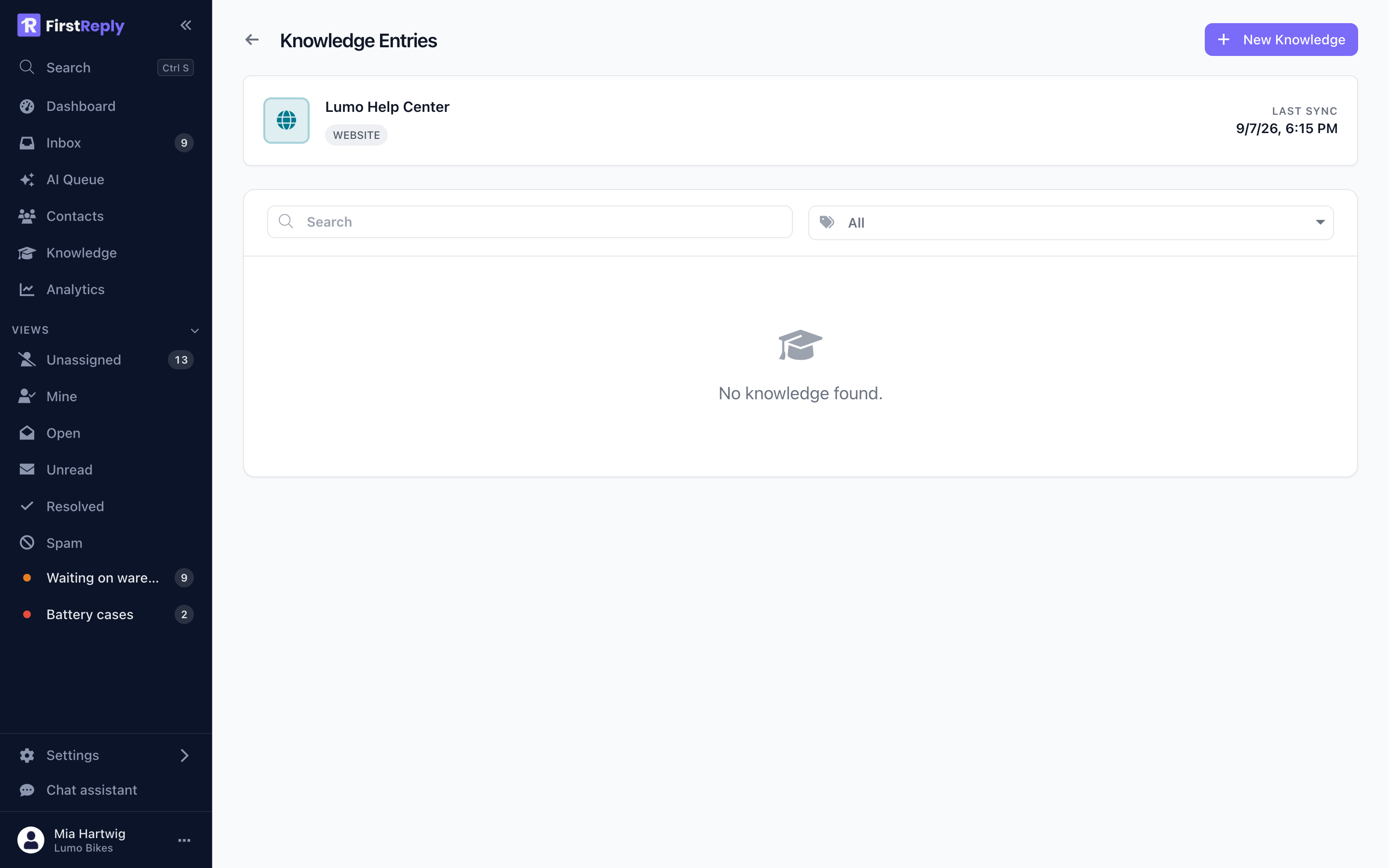
The list shows the title, the source it came from and when it was last synced. Search it to check whether something is documented before you answer it by hand.
An article
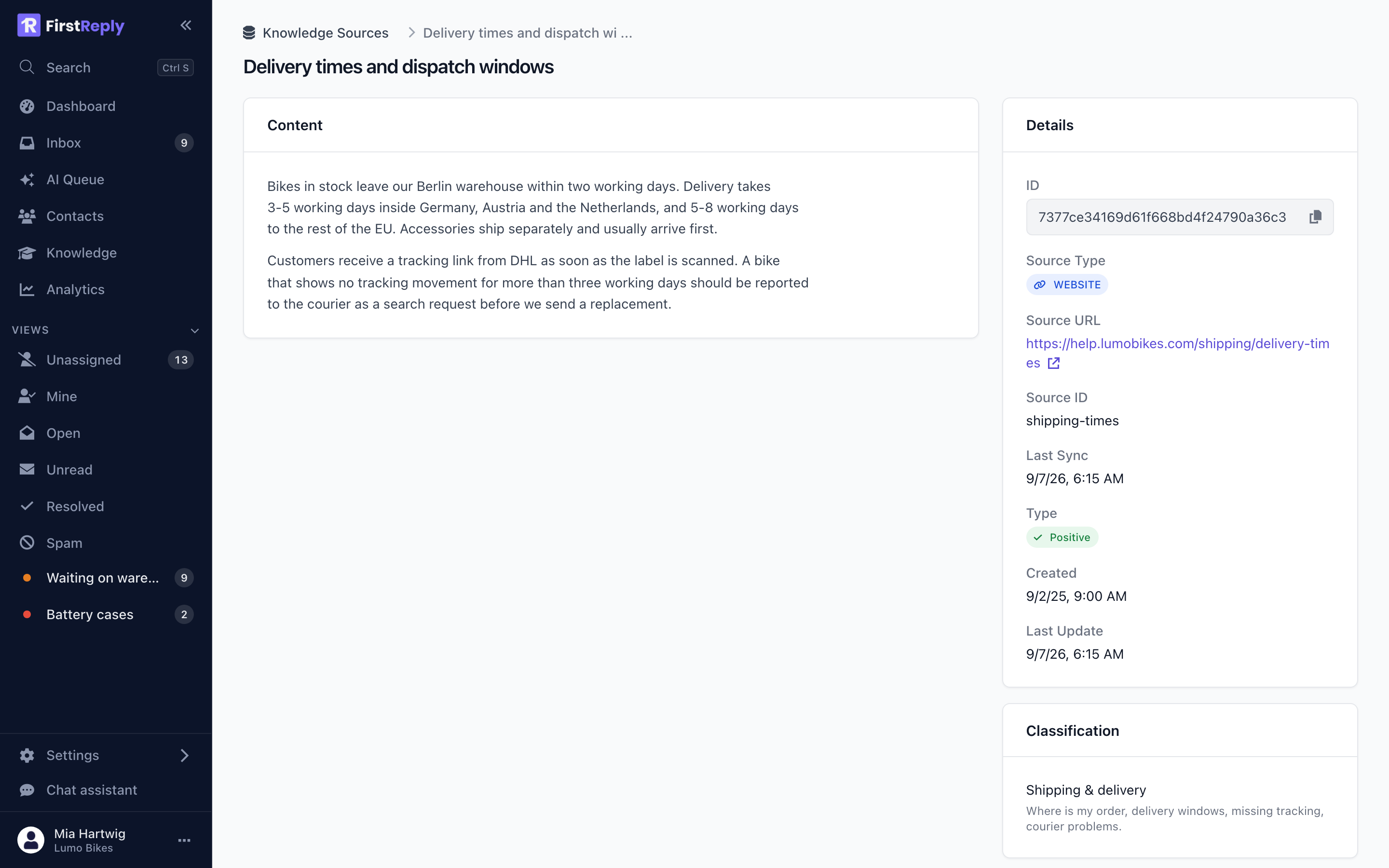
An article has a title, a body, an optional link back to the original page, and an optional classification that ties it to a category.
Synced articles show their source link, which is the link the assistant gives a customer when it points them at further reading. Keep the source pages public, or the link is useless to the person receiving it.
Writing one by hand
Manual articles cover what exists nowhere else. Add one from the knowledge section; it needs the Manager role or higher.
Manual articles are never touched by a sync, so they will not be overwritten by a source and will not disappear when a crawl fails. They are also never updated for you, which is the trade.
Use them for:
- Internal policy that is not on your website.
- Tone of voice rules and reply patterns.
- Escalation rules — when a conversation must go to a person.
- The exceptions your team knows and has never written down.
Classification
Attaching a classification to an article ties it to a category. It helps retrieval prefer the right material when a conversation is already classified, and it makes the knowledge base easier to audit: filter by category and you can see whether Returns is actually covered.
Leave it empty for articles that apply everywhere, like tone of voice.
Chunks
A long article is split into chunks of a few paragraphs when it is indexed, each retrievable on its own. You edit the article; the chunking happens underneath.
This is why an article's structure matters. A clear paragraph break between two topics produces two clean chunks. A wall of text produces chunks that each contain half of two ideas.
Editing and deleting
Edit a manual article at any time; the change is indexed within a minute or two.
Editing a synced article is possible but is not a good idea: the next sync overwrites it. Change it at the source instead. If a source page is wrong and you cannot change it, exclude the page from the crawl and write a manual article in its place.
Deleting removes the article from the knowledge base and from what the assistant can see. It is the right fix for an article you no longer stand behind — an out-of-date article is worse than a missing one, because it produces a confident wrong answer rather than a hand-over.
Checking that it works
The fastest test is in a real conversation. Open one, use Find answer, and see which passages come back. If your new article is not among them for a question it clearly answers, the problem is the title and first paragraph rather than the body.
Writing good knowledge covers the patterns that retrieve well.