The knowledge base
The knowledge base is the single source the assistant answers from. It does not answer from general world knowledge, and it does not fill gaps with plausible guesses. If your knowledge base says nothing about international shipping, the assistant will not invent a policy for it — it hands the conversation to a person.
That constraint is the reason the knowledge base deserves more attention than any other setting in the product.
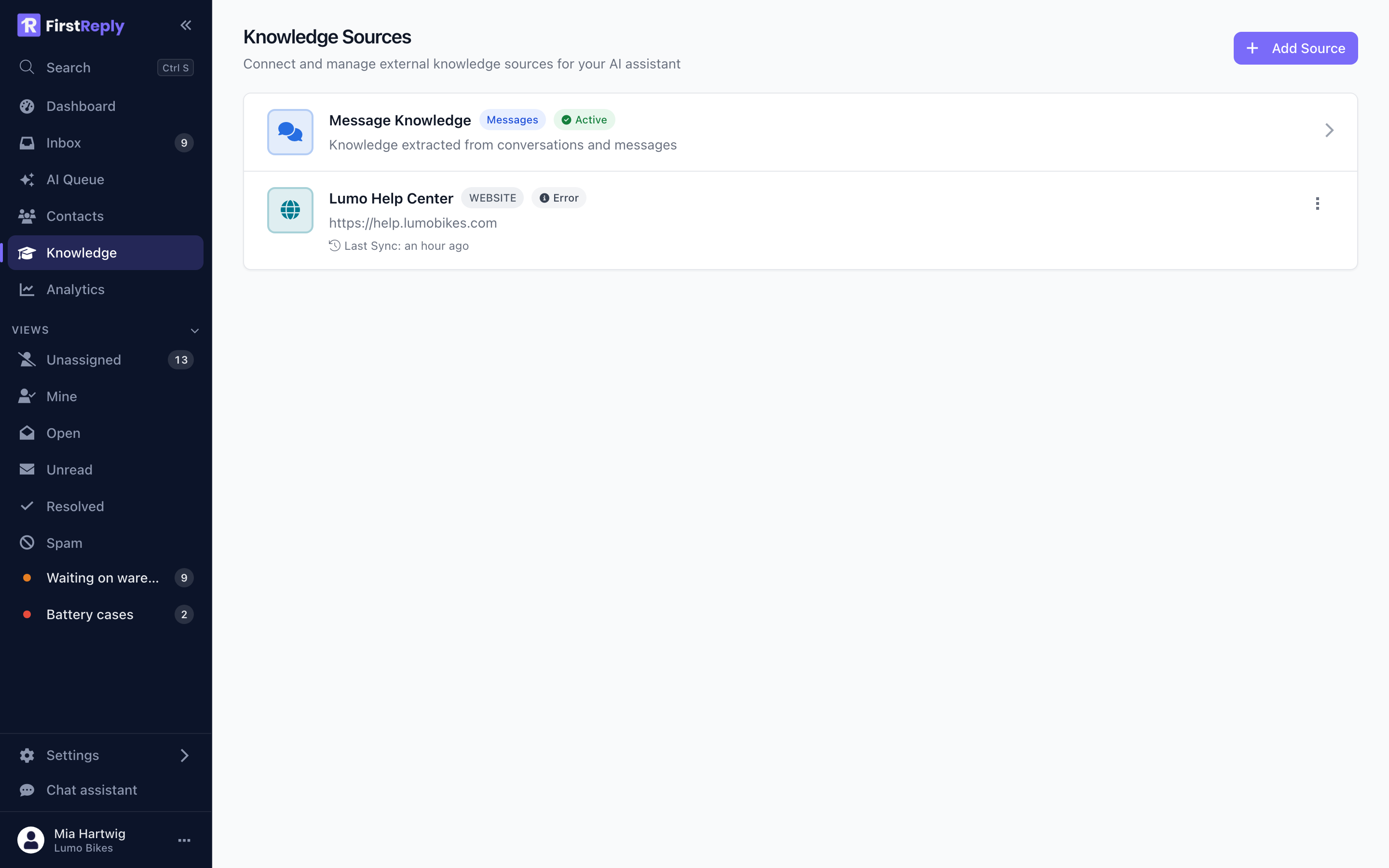
How it is put together
Knowledge reaches the base in two ways.
Synced sources connect to something you already maintain: a help center, a documentation site, a Notion space, a GitHub repository. FirstReply fetches the content on a schedule and keeps it current, so the knowledge base does not drift away from the truth. See Knowledge sources.
Manual articles are written in FirstReply itself. Use them for the things that exist nowhere else: internal policy, tone of voice, the exceptions your team knows by heart. See Articles.
Both end up in the same place and are searched the same way.
Chunks, not documents
A long help article is not stored as one lump. It is split into chunks of a few paragraphs each, and each chunk is indexed on its own.
This matters in practice. A 3,000-word shipping page contains a paragraph about island addresses; without chunking, that paragraph competes with the whole rest of the page and rarely wins. With chunking, it is retrievable on its own, and the assistant gets that paragraph rather than the whole page.
You do not manage chunks yourself. The splitting happens on sync, and the source article stays the unit you edit.
How retrieval works
When the assistant needs an answer it runs two searches at once:
Semantic search compares the meaning of the question with the meaning of every chunk, using embeddings. It finds the article about "range in cold weather" for a customer asking "how far will it go in winter", even though the two share no words.
Full-text search matches actual words. It finds the chunk containing an exact part number, a model name, or an error code, which semantic search is bad at.
The two result lists are combined with reciprocal rank fusion: a chunk that both searches rank highly wins, and a chunk that only one of them found still gets a chance. The result is more robust than either search alone.
The assistant receives each retrieved chunk with its title, its source link and its text, which is how it can point customers at the underlying article.
What good looks like
A knowledge base is working when:
- Most conversations get an answer with sources rather than a hand-over.
- The hand-overs it does produce are about genuinely new questions.
- Corrections your team makes to AI replies are rare and specific.
If the assistant hands over constantly, the knowledge base is too thin. If it answers confidently but wrongly, the knowledge base contains something out of date or ambiguous, and the fix is in the article, not in the prompt.
Writing good knowledge covers the article patterns that retrieve well.
Where knowledge shows up
Besides the automatic replies, the knowledge base is available to your team directly:
- Find answer in a conversation searches it and shows the passages, with sources, without writing a reply.
- Draft reply writes an answer from the same passages.
- The Knowledge section in the sidebar lets you browse and search everything the assistant can see.